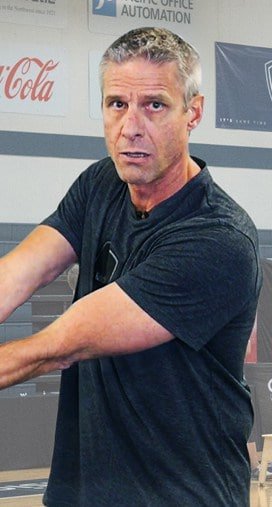
Interview by Don Patterson:
Few people in the sport of volleyball have as impressive a resume as Pat Powers. As an indoor player, his highlights include a national championship at USC in 1980, an Olympic gold medal with the U.S. men’s national team in 1984 and a World Championship in 1986. On the beach, he won 12 tournaments with six different partners (including Karch Kiraly) and more than half a million dollars in prize money. Since retiring from playing, he has turned his focus to coaching. He was head coach of the men’s team at USC from 1997-2002 and now coaches junior club ball and runs player camps nationwide. Art of Coaching interviewed him recently to find out more about how he teaches the game to the youth of America.
AOC: You have a unique way of teaching passing. Tell us about it.
PP: The first thing I do is explain it the way other coaches would explain it – how to execute it.
Next – and I think this is somewhat unique – I overcorrect what they’re doing wrong. So, to use a golf analogy, if I have a player who slices the ball, I turn them into a player who snap hooks it.
For example, when I’m teaching passing at my camps, I have players bend over as they’re passing and touch the ground. That, in itself, is an overcorrection.
AOC: What are you emphasizing when you have players touch the ground?
PP: The hardest thing to do (with young athletes) is not teaching them how to be volleyball players but teaching them how to be athletic. In sports, we define athleticism as waist bend. You see players bent over on a basketball court or a football field or a volleyball court because when you bend over, you’re faster, quicker, more agile. So many young volleyball players stand straight up when they play the game, and you can’t do that. You want to be ready to move.
AOC: You invented a game called “Survivor” that helps kids learn. How does it work?
PP: It’s like a Queen or King of the Court game. The first ball I throw over the net, they have to start executing skills that I’ve explained and they’ve drilled on briefly.
So the first ball that comes over, they have to have their shoulders out, almost locked, arms in front of their face. You can’t move your arms when the ball is 30 feet or a second and half away, and you have to have the correct foot forward because it influences and orients your platform, your angle, your arms. And as they pass a ball, they have to bend over and touch the ground.
So that’s the first rule of survivor. If they don’t do what I just described, I’ll say, “Stop,” and I’ll say their name. So “Stop, Amanda! Next time, put your left foot forward.” Or “Stop, Joe! Next time, bend at your waist, not your knees when you’re passing.”
I started this game 23 or 24 years ago, and it’s really fun, but the players also get a little bit mad at me as we go through this. It can be frustrating at first. But then they start to get it, and they start to understand it. So in a very short period of time, I’ve taught them how to pass, and probably more importantly, how to remain athletic while they’re passing.
AOC: What’s something that coaches should emphasize with young players when they’re teaching serving?
PP: Well, it depends. There’s a difference between the women’s game and the men’s game. The men’s game is all about serving tough to get the other team to pass balls off the net and get out of system. The women – they want to serve tough, but they don’t want to miss serves.
What I try to emphasize with the women is to serve out of the elbow and not the shoulder. Because what I see at the younger ages is they try to power the ball from the shoulder and they pull forward with their arm. By doing that, you lose what we call extension on the serve as defined from the shoulder to the elbow. When you serve a ball, you want to have extension. You want it pretty high in the air. So to overcorrect, what I do is I first have them stop their hand after they serve a ball, and that forces them to serve from their elbow and not their shoulder. And then I have them hit the ball as hard as they can and pull their hand back. By doing that, you’re indenting the ball. That’s what gives it movement. You’ll see this in college volleyball – about 30 to 50 percent of the players hit the serve and pull their hand back.
AOC: After 30 years of coaching, what’s something you think is important for coaches, parents and players to know?
PP: I always say that the number one rule in juniors’ sports is that nobody wants to play with worse players. So the emphasis at my clinics has been that the reason you want to do this is not so much that you’re going to play better but, just as important, you look better. And not only do you look better in front of the coaches so you stand a better chance of making the team you’re trying out for, but you look better to other players. And if the other players see you doing things differently and doing things better, they naturally gravitate toward you. If you don’t do skills well and you’re not getting better, other players gravitate away from you.
AOC: You say no one wants to play with worse players. Does this highlight why it’s important that young players aren’t pushed up to a higher-level team that they shouldn’t be on?
PP: Yeah. If a player is on the 15 threes, they might be in the top three or four players on the team. Well, if I move that player up to the 15 twos and all of a sudden they’re like the ninth best player, 10th best player, well, guess what? The same rule kicks in. No one wants to play with worse players. So the top two or three players on that team don’t want to play with you. And the parents of the top two or three players don’t want you on the court as well. And that situation right there is what causes 90 to 95% of the problems in club volleyball. And I’m sure it’s true for all club sports. So coaches should keep players where they should be. If the kids stayed on the team they should be on there would be a lot more harmony.
AOC: Do you have advice for up-and-coming coaches?
PP: One thing is, you can’t take things personally. Because in the sport, somebody, something’s going to make you mad. It’s going to be the other coach, the referee, your players, the other players, the parents. So you have to have a thick skin and stick to your guns.
The other thing is, I always listen to what other coaches have to say and ask questions. What do you do in certain situations? How do you deal with difficult players? I’ve never stopped trying to be a student. I always try to pick up what other coaches know because you can get some great nuggets of advice.